
On screen · opening
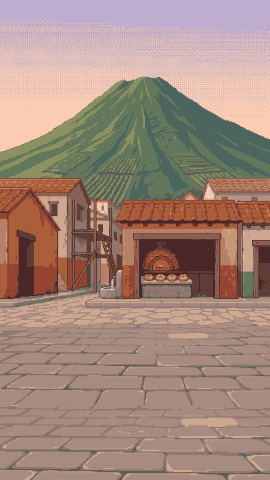
To everyone here, the mountain is just a mountain.
EP.01 · Codex entry
Pompeii, 79 AD · “Eighty-One Loaves”
In 79 AD Mount Vesuvius erupted and buried the Roman town of Pompeii under metres of pumice and ash. The Short follows Felix, a fictional baker, through the town's last ordinary morning. This is the history behind it.

A baker. He stands in for the thousands of people in Pompeii whose names we'll never know.

His daughter, about eight. She stamps the loaves.
Days of small earthquakes before the eruption, shrugged off as normal for Campania.1
The eruption column at about 1 pm, shaped like an umbrella pine.1
Pumice and ash falling all afternoon and night.2
Round loaves scored into eight wedges, marked with the maker's bread stamp.5
81 loaves found in a sealed bakery oven in 1862.4
Pliny the Younger writes that tremors had been felt for many days. They caused little alarm, because earthquakes were common in Campania.1 Parts of the town were still being rebuilt after a large earthquake in 62 or 63 AD.6
Papa! The ground is shaking again!
Pompeii's round loaves were scored into eight wedges before baking, and bakers pressed a stamp into the dough to mark whose bread it was.5
Eighty-one loaves today. Best bread in Pompeii.
Across the bay at Misenum, Pliny's mother pointed out a cloud of unusual size and shape. Pliny compared it to an umbrella pine: a tall trunk rising high, then spreading out at the top.1
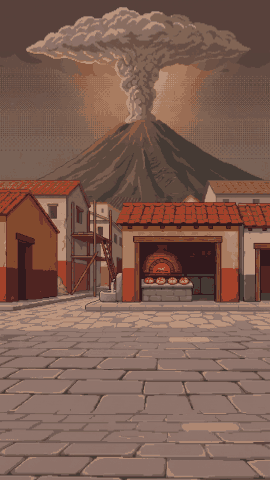
Pumice and ash fell on Pompeii for 18 to 20 hours, building up to 2.8 metres deep.2

Leave the bread. Take my hand. RUN.
Pyroclastic surges, fast clouds of hot gas and ash, reached the town. Those still in the town were killed.2
Excavation began about 1,670 years after the eruption.7
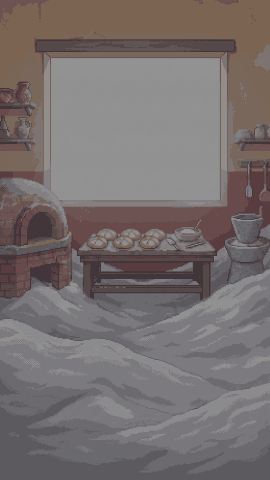
1862. Archaeologists open a bakery oven in Pompeii.
Inside: 81 loaves of bread.
Felix is fictional. The bread is real.
Each line from the Short that makes a historical claim, beside what the record says.
To everyone here, the mountain is just a mountain.
Eighty-one loaves today. Best bread in Pompeii.
The number comes from the find: 81 carbonised loaves in the oven of the Bakery of Modestus.4 Some accounts count 80. Whether they were being baked that day or stored is debated. Felix's boast is our invention.
High
It shakes every week. The gods owe us some quiet.
Pliny writes that tremors had been felt for many days and caused little alarm, because they were common in Campania.1 "Every week" is our dramatisation.
HighPliny dates the column to about the seventh hour, roughly 1 pm.1 The date itself is this entry's open question.
HighStones rain from the sky all afternoon. All night.
The pumice phase of the eruption lasted 18 to 20 hours and left up to 2.8 metres of pumice on Pompeii.2
HighThe town is buried. It sleeps for almost 1,700 years.
For centuries the eruption was dated to 24 August, from medieval copies of Pliny's letter. In 2018, archaeologists in Pompeii found a charcoal scribble on a wall dated to 17 October. Charcoal fades fast, so it was most likely written that same October, a week before the eruption.310
Most experts now lean towards 24 October, but it is still debated.
ContestedTwo letters to the historian Tacitus by an eyewitness who watched from Misenum, across the bay. The only surviving eyewitness account.
Overview of the eruption's phases, timing and the dating debate, with references to the volcanology (Sigurdsson et al., 1982).
Report on the 2018 charcoal inscription and what it means for the date.
The 1862 find in the Bakery of Modestus, and the debate over the count.
How the loaves were shaped, scored and stamped.
The earlier earthquake and the repairs still under way in 79.
The town's history and the story of its excavation from 1748.
What Romans knew about Vesuvius before 79.
A general account of the eruption and the farmland on the mountain.
A second report on the 2018 inscription.
History's NPCs. "The eruption of Vesuvius (Pompeii, 79 AD): Eighty-One Loaves." The Codex, 2026. https://historysnpcs.com/01-pompeii/