
On screen · opening
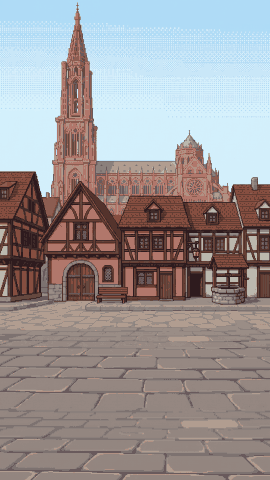
Today, a woman in this street starts to dance. She won't stop for days.
EP.07 · Codex entry
Strasbourg, 1518 · “Dance It Out”
In the summer of 1518, hundreds of people in Strasbourg danced for days on end, and the city's cure was more music. The Short follows Veit, a fictional street fiddler, from the morning the first woman began to dance to the weeks when the council paid bands to keep the dancers going. This is the history behind it.

A street fiddler. He stands in for the people whose names we'll never know. Veit is the German form of Vitus, the saint the city blamed.

His daughter, about nine. Saint Odile is the patron saint of Alsace.
A woman who began dancing alone in the street in mid-July 1518 and kept on for days.12
Physicians who called it a natural disease of overheated blood and prescribed more dancing.12
A council that cleared guild halls, built a stage at the horse market and paid musicians to keep the dancers moving.125
A ban on public music and dancing, and dancers carted to a shrine of Saint Vitus and given red shoes.13
A run of bad harvests, famine, disease and unrest left Strasbourg under severe strain. The historian John Waller sees that strain as the root of what followed.16
Bad harvests. No weddings, no fairs. Who pays a fiddler now?
A woman, named in four of six chronicles as Frau Troffea, began to dance alone in the street, with no music. She kept on for four to six days and was then taken by wagon to the shrine of Saint Vitus at Saverne.13
Today, a woman in this street starts to dance. She won't stop for days.
Within a week, 34 others had joined her.2 The physicians ruled out curses and the stars: it was "a natural disease" caused by overheated blood, and the cure was to dance it out.12

The doctors say it's hot blood. Dance it out, they say.
The council cleared two guild halls and the grain market, built a wooden stage at the horse market and paid musicians (drums, fiddles, pipes and horns) and healthy dancers to keep the afflicted moving.125 It made things worse: onlookers took the dancing for Saint Vitus's wrath, and more joined in.1
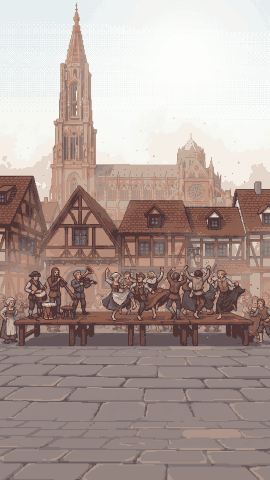
The Imlin family chronicle says the dancing seized 400 people within a month.12 Accounts describe dancers collapsing from exhaustion; how many died, if any, is disputed.34
Within a month, one chronicle counted 400 dancers.
The council tore down the stages and banned almost all public music and dancing. The worst affected were carted to Saverne, where priests gave them small crosses and red shoes marked with holy oil. By September the outbreak had faded.13
The worst were carted to a St Vitus shrine and given red shoes.
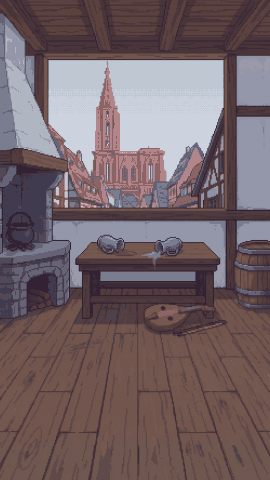
Physicians blamed overheated blood. Their cure: more dancing.
The council paid musicians to play for the dancers. Then it banned most music.
Veit is fictional. The council's band is real.
Each line from the Short that makes a historical claim, beside what the record says.
Today, a woman in this street starts to dance. She won't stop for days.
Bad harvests. No weddings, no fairs. Who pays a fiddler now?

Papa, thirty people are dancing now! They can't stop!
The doctors say it's hot blood. Dance it out, they say.

Papa, they paid you to play. Why is it getting worse?
Within a month, one chronicle counted 400 dancers.
The worst were carted to a St Vitus shrine and given red shoes.
The council paid musicians to play for the dancers. Then it banned most music.
One chronicle says that for a time the dancing killed about fifteen people a day, and Waller writes that the chronicles agree dozens died.24
But the city's own records from that summer do not mention deaths, and the accounts that do were written later.3 Nobody knows the real toll.
ContestedThe fullest readable account, quoting the chronicles of Specklin and the Imlin family, Paracelsus and the council's decree.
The leading historian of the outbreak on its course, the physicians' diagnosis and the council's response (excerpt).
Overview, including how many sources name Troffea and why the death toll is disputed.
Waller's case for stress-induced mass psychogenic illness, with the chronicle's claim of fifteen deaths a day (excerpt).
Short account of the council's stage and musicians and the kinds of records that survive.
The competing explanations, and the hardships the city was living through.
History's NPCs. "The Dancing Plague of 1518 (Strasbourg, 1518): Dance It Out." The Codex, 2026. https://historysnpcs.com/07-dancing-plague/